Industrial mixers
Vertical vacuum mixer dryer
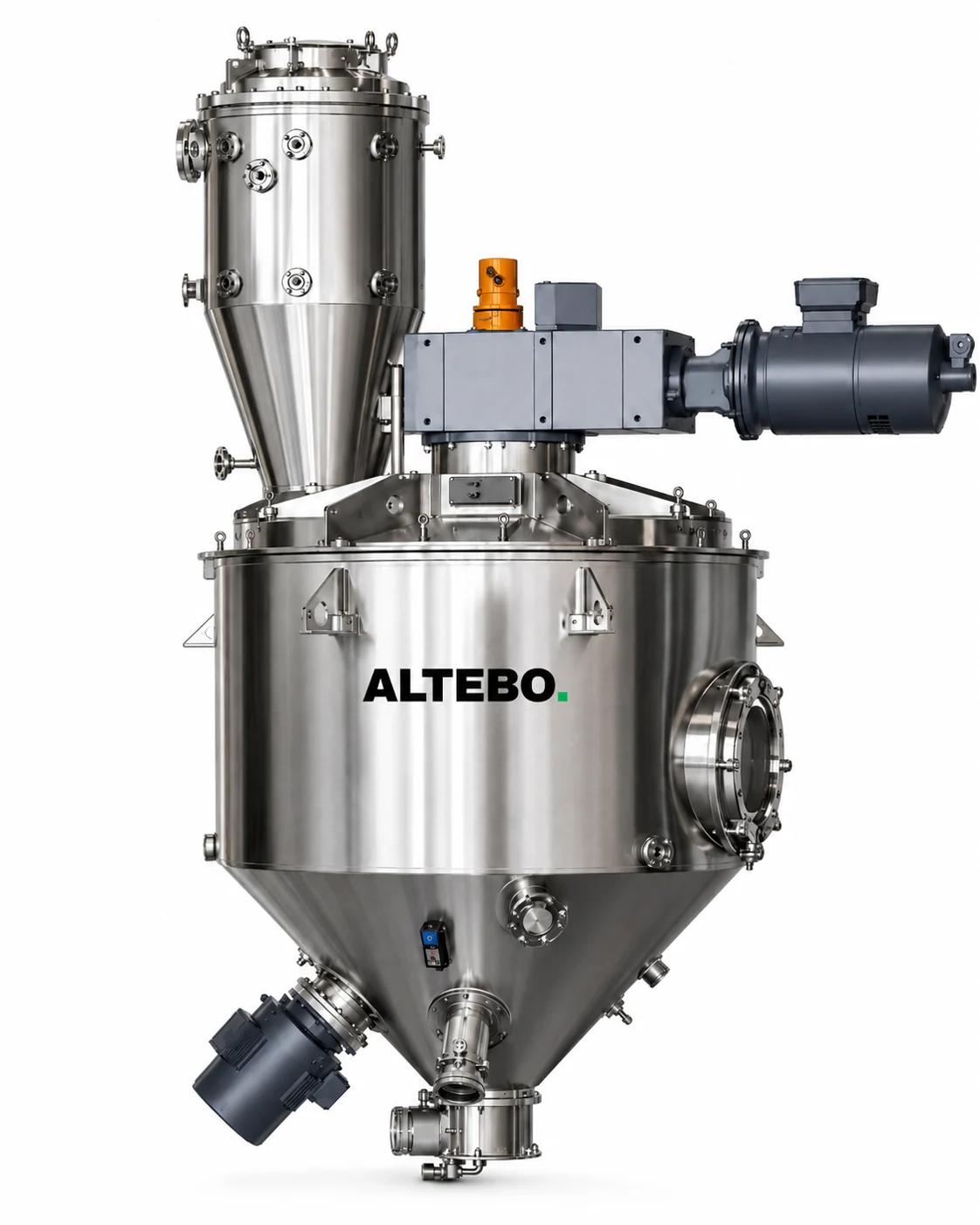
Vertical stainless vessel with a helical or ribbon mixing element, a thermal jacket and vacuum operation — for products that have to be intensively homogenised and dried in the same machine. Built routinely between approx. 500 and 20,000 L.
- Usual configurable range
- approx. 500 – 20,000 L
- Usual installed power
- approx. 7.5 – 160 kW
Also known as: vertical vacuum dryer · vacuum ribbon dryer · vertical mixer dryer
Individually sized on your material and your process. Technical proposal and price normally within 48 hours. Delivery across the EU and the Republic of Moldova.
How it works
The vertical construction combines a helical or ribbon mixing element — which produces energetic axial and radial circulation — with vacuum drying. It is the machine to choose when the product has to be properly homogenised, not only gently dried: in a conical mixer the mixing is deliberately slow, here it is active.
The jacket covers the cylindrical body and the discharge cone, while vapour passes through the lid filter to the condenser. Under vacuum the solvent boils at low temperature, so heat-sensitive products keep their properties. The conical bottom empties the batch completely by gravity.
It is equipped with load cells for gravimetric dosing directly in the vessel, with a CIP system when product changes are frequent, and with instrumentation and automation for recipes with a temperature profile. AISI 304 covers most applications; AISI 316L is chosen when the product or the cleaning agent brings chlorides or acids.
Active mixing
Helical or ribbon element: axial and radial circulation, not just slow lifting of the material.
Vacuum drying
The solvent boils at low temperature, so heat-sensitive products do not degrade.
Jacket on body and cone
Heat transfer area on the discharge zone too, where material would otherwise stay wet.
Dosing in the vessel
Optional load cells: components are weighed directly in the machine, with no separate scale.
Internal construction
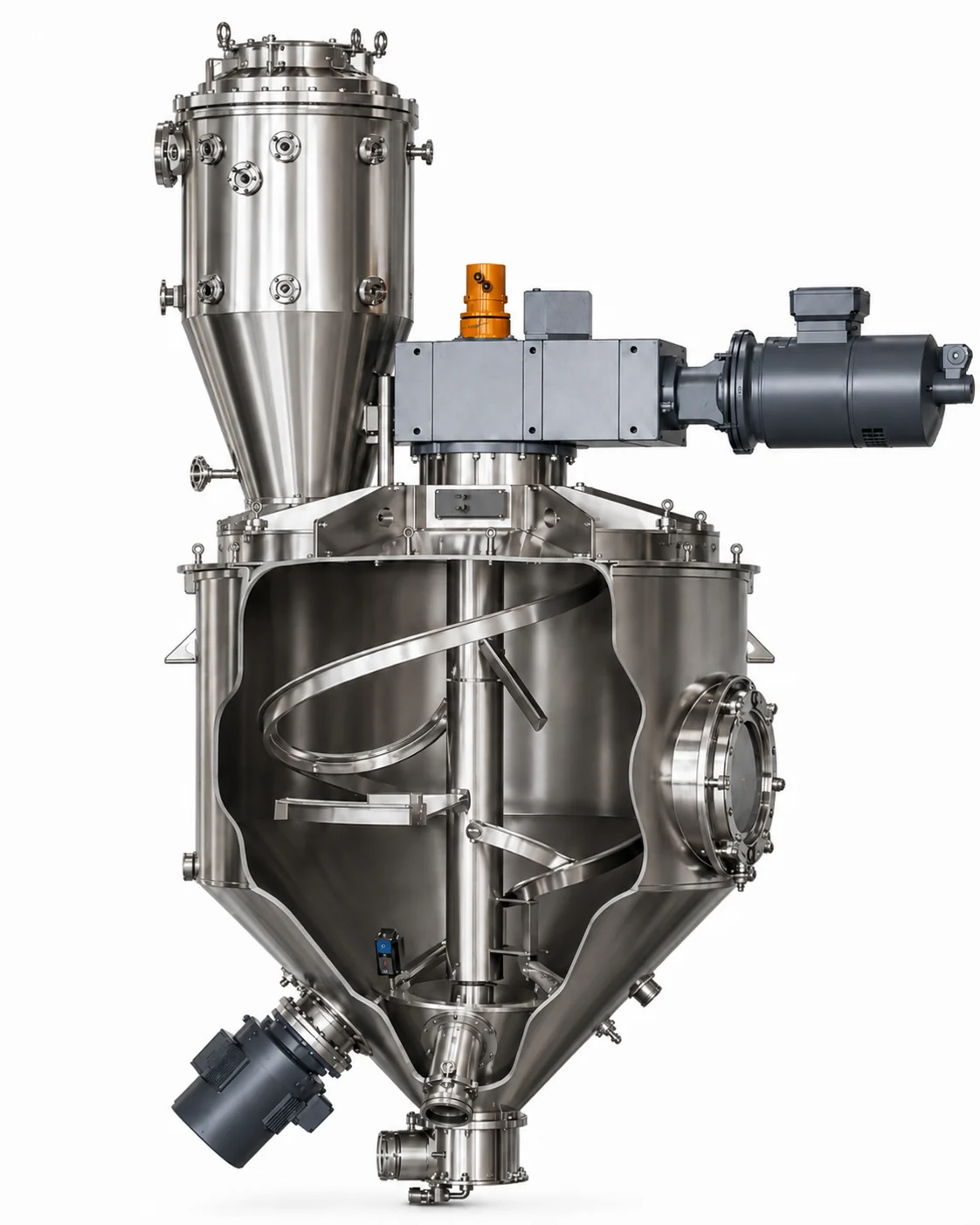
What happens inside
Cutaway view: the helical element on the central shaft, the jacket on the body and on the discharge cone, and the vapour filter mounted in the lid.
When to choose it
The concrete situations in which this machine is the right answer — and the one in which we would point you to something else in our range.
The product has to be both intensively homogenised and dried: in a conical dryer the mixing is deliberately gentle and does not go far enough.
You need gravimetric dosing directly in the vessel, with a batch report, without a separate scale upstream.
The material is heat-sensitive and has to be dried below the temperature at which it degrades.
Floor space is limited: a vertical construction takes up less area than a horizontal one at the same volume.
When this is NOT the right machine
If the material cakes heavily during drying and has to be broken up mechanically while the process runs, you need choppers working independently of the main element.
See Horizontal vacuum ploughshare dryer