Dosing and big bag systems
Big bag discharge station
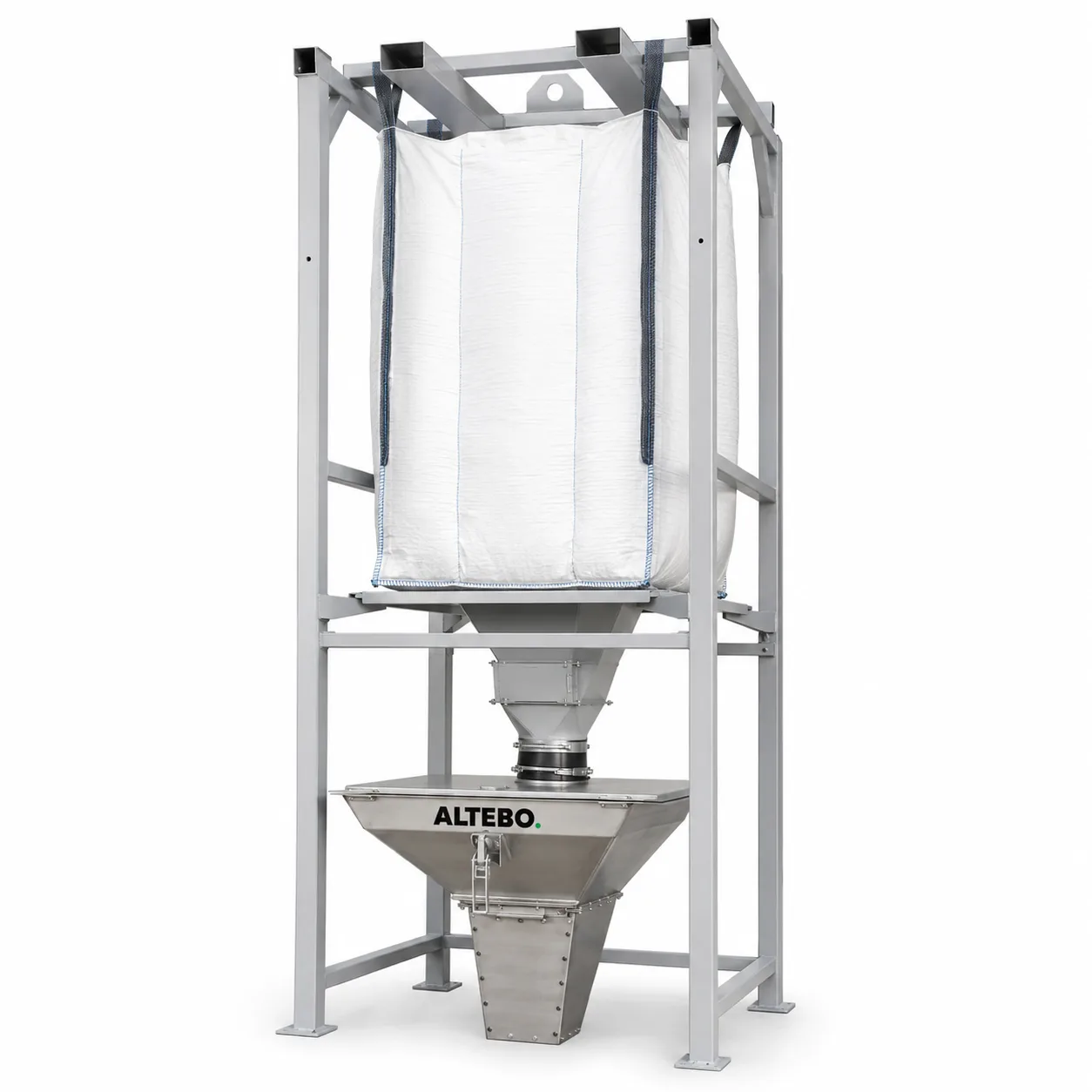
Closed-circuit big bag emptying station, with no dust in the hall — vibrating cone Ø 1,250 or 1,500 mm, discharge spout Ø 273 mm, filter sleeve for dust extraction. Carbon steel, AISI 304L or 316L.
Also known as: FIBC unloading station · big bag emptying station · bulk bag unloader
Specifications
| Structure materials | Carbon steel, AISI 304L or AISI 316L |
|---|---|
| Vibrating cone | Ø 1,250 mm or Ø 1,500 mm |
| Discharge spout | Ø 273 mm |
| Dust extraction | Filter sleeve + mechanical vibrator |
| Vibrator mounting | Anti-vibration bearings with rubber gaskets |
| Lifting versions | Electric hoist · existing overhead crane · monorail |
| Options | Single-use bag cutting · pneumatic hammer with electro-pneumatic panel |
The figures above are the ranges we build routinely, not construction limits. We design and manufacture any capacity, power rating and envelope to order — including below or above the ranges in the table.
Industrii
- Chemicals
- Food
- Construction
- Pharma
- Individually sized — on your material, throughput and space
- Technical proposal and price, normally within 48 hours
- Installation, commissioning and service from our own plants
When to choose it
The concrete situations where this machine is the right answer — and the one where we recommend something else from our range.
You receive raw material in big bags and powder reaches the hall at every emptying — sealing on the bag neck plus the filter sleeve close the circuit.
The material compacts in the bag and does not flow on its own: the vibrating cone releases it, and for heavily compacted materials a pneumatic hammer is added.
You work with expensive raw materials and want full recovery — what stays in the bag and what escapes as dust are direct losses.
You already have a crane or a monorail in the hall: the system is modular, so it is configured around the lifting equipment you have, without buying another.
When this is NOT the right machine
If your raw material arrives in small 25 kg sacks, a station sized for big bags is oversized.
Vezi Gravimetric screw feederHow it works
The big bag discharge station takes bulk materials delivered in large bags and introduces them into the process in a closed circuit: the neck of the bag seals against the discharge hopper, so the powder never reaches the hall atmosphere — a requirement of hygiene, of operator protection and of recovering the raw material in full.
The modular system consists of the support frame with the discharge hopper and the lifting cross to which the four straps of the bag are attached. The cross with the bag is lifted and set into the frame, the bag neck is tied onto the hopper's sealing gasket, and the vibrating cone with a mechanical vibrator releases compacted material and ensures the bag empties completely.
The construction is built in carbon steel, AISI 304L or AISI 316L, with a vibrating cone of Ø 1,250 or 1,500 mm, a discharge spout of Ø 273 mm and a filter sleeve for dust extraction, mounted on anti-vibration bearings with rubber gaskets.
Bag lifting is solved for the situation in the hall: a height-adjustable frame with an electric hoist, a version for an existing overhead crane, or a monorail arrangement. Optionally, the system is completed with a cutting device for single-use bags and a pneumatic hammer with an electro-pneumatic control panel, for heavily compacted materials.
Closed circuit, dust free
Sealing on the bag neck and a filter sleeve for dust extraction.
Vibrating cone Ø 1,250 / 1,500 mm
Releases compacted material — the bag empties completely.
Modular system
Frame, hopper and lifting cross configured per application.
Lifting to suit the hall
Electric hoist, existing overhead crane or monorail.
Variante constructive
What actually differs between them — not just what they are called.
Adjustable frame with electric hoist
The complete system, with its own lifting equipment. Chosen when there is no crane in the hall — you do not depend on another machine to place the bag on the frame.
Version for an existing crane
Frame and hopper only; the bag is brought by the hall crane. The lowest cost, but it occupies the crane at every emptying.
With a monorail
An overhead rail with a hoist, for halls where bags arrive along a fixed, repetitive route.
With a cutting device
For single-use bags that do not open at the neck — the bag is cut automatically above the hopper.
With a pneumatic hammer
An electro-pneumatic control panel and a hammer striking the cone, for heavily compacted materials that the vibrator alone will not release.
Frequently asked questions
Question not answered here? Write to us — an engineer replies, nu un robot.
Does no dust really escape into the hall?
The principle is sealing the bag neck on the hopper gasket, backed by the filter sleeve that captures the dust raised during emptying. The circuit is closed from the bag through to the downstream machine.
What do I do if the material has compacted in the bag?
The vibrating cone with its mechanical vibrator releases the material — that is the standard equipment. For heavily compacted materials that do not respond to vibration, a pneumatic hammer with an electro-pneumatic control panel is added.
We already have a crane in the hall — do I need to buy a hoist?
No. The system is modular: there is a version for an existing crane, in which you receive only the frame and the hopper. The drawback is that you occupy the crane at every emptying — if it is also used for other work, your own hoist or a monorail frees it up.
What bag weight will the frame support?
See the “Maximum bag load” row in the specification table — the figure covers both the frame and the lifting cross.
Can it be connected directly to a mixer or a feeder?
Yes — the Ø 273 mm discharge spout connects to the downstream machine. Most often, the station feeds a screw conveyor or a gravimetric feeder, within the same closed circuit.
Which build material should I choose?
Carbon steel for non-aggressive materials and general industrial applications; AISI 304L for food and mildly corrosive media; AISI 316L when the material contains chlorides or acids. Tell us what powder you are discharging and we will recommend the build.