Industrial mixers
High-tonnage ribbon blender
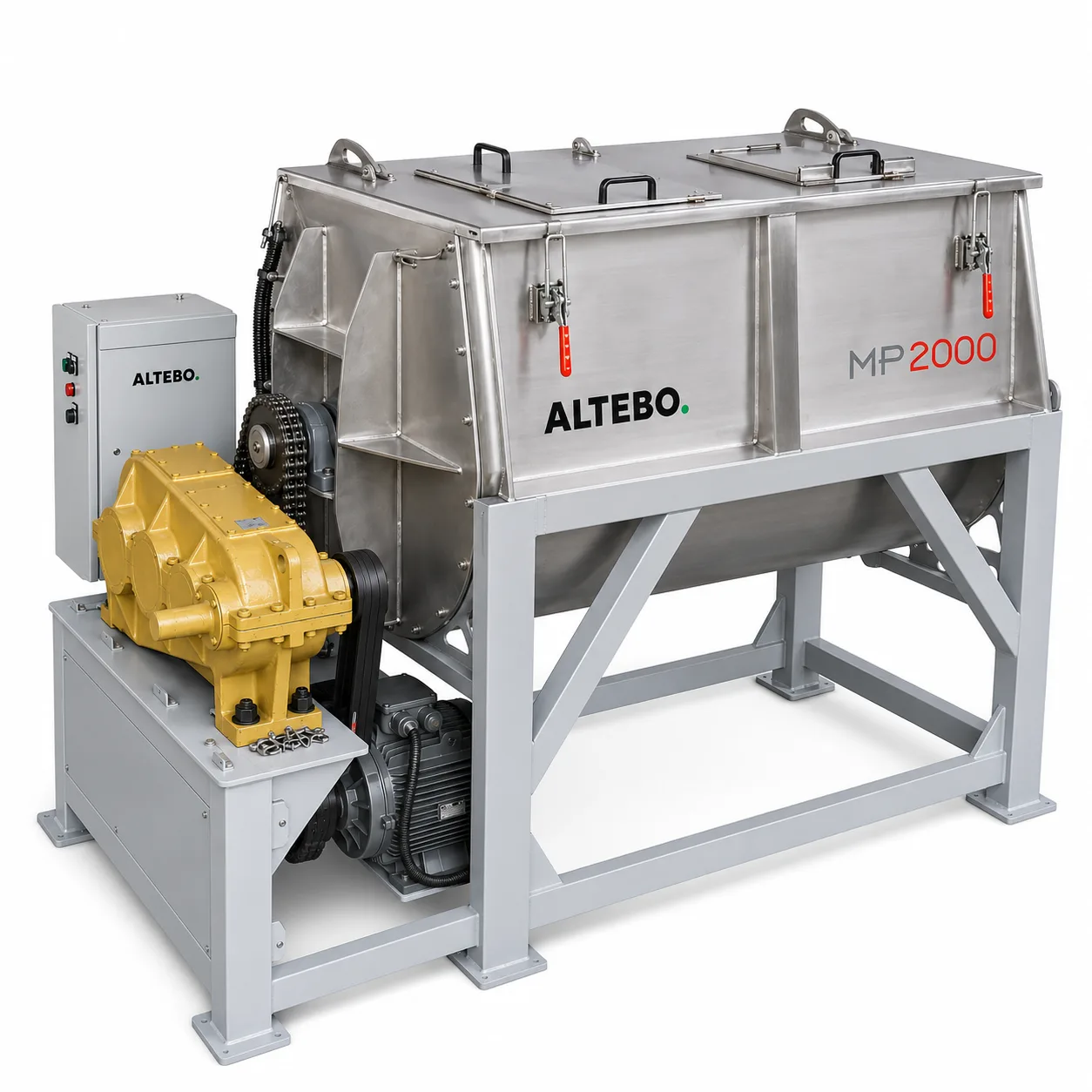
Reinforced ribbon blender for batches from 5,000 L upwards — fertilisers, construction materials, agricultural premixes. Starts with the trough full, without emptying it first.
Also known as: large capacity ribbon mixer · heavy-duty industrial blender
Specifications
| Capacity | 5,000 – 20,000 L / batch |
|---|---|
| Product contact material | AISI 304 / 316L stainless or protected carbon steel |
| Motor power | 22 – 110 kW |
| Drive | Industrial high-torque gearmotor |
| Bearings | Mounted outside the trough, clear of the product zone |
| Options | Load cells · inspection hatches · integration into the line control |
The figures above are the ranges we build routinely, not construction limits. We design and manufacture any capacity, power rating and envelope to order — including below or above the ranges in the table.
Industrii
- Chemicals
- Construction
- Agriculture
- Individually sized — on your material, throughput and space
- Technical proposal and price, normally within 48 hours
- Installation, commissioning and service from our own plants
When to choose it
The concrete situations where this machine is the right answer — and the one where we recommend something else from our range.
You work with multi-tonne batches and need the same homogeneity as at small volumes — the ribbon geometry is recalculated for the load of the whole batch, not simply scaled up.
The line stops and restarts with material still in the trough: the high-torque drive allows starting under load, without emptying the mixer by hand.
You produce fertilisers or construction materials, where the trough works with abrasive compositions and the structure has to be sized above standard.
You want to remove a separate dosing unit: the mixer is mounted on load cells and weighs the components straight into the trough.
When this is NOT the right machine
Below 5,000 L per batch, the reinforced construction and the high-torque motor are costs with no return in the process.
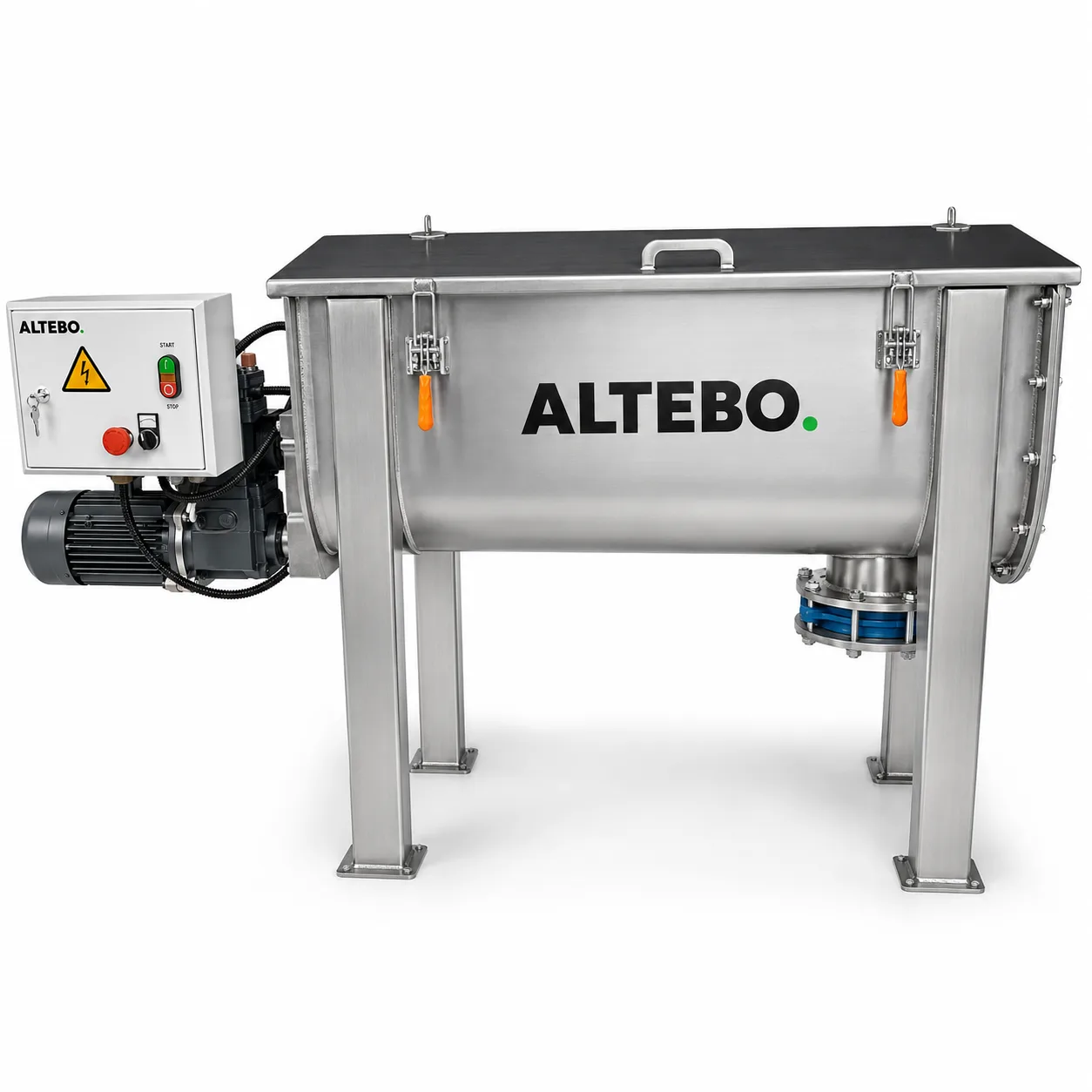
Vezi Standard ribbon blenderHow it works
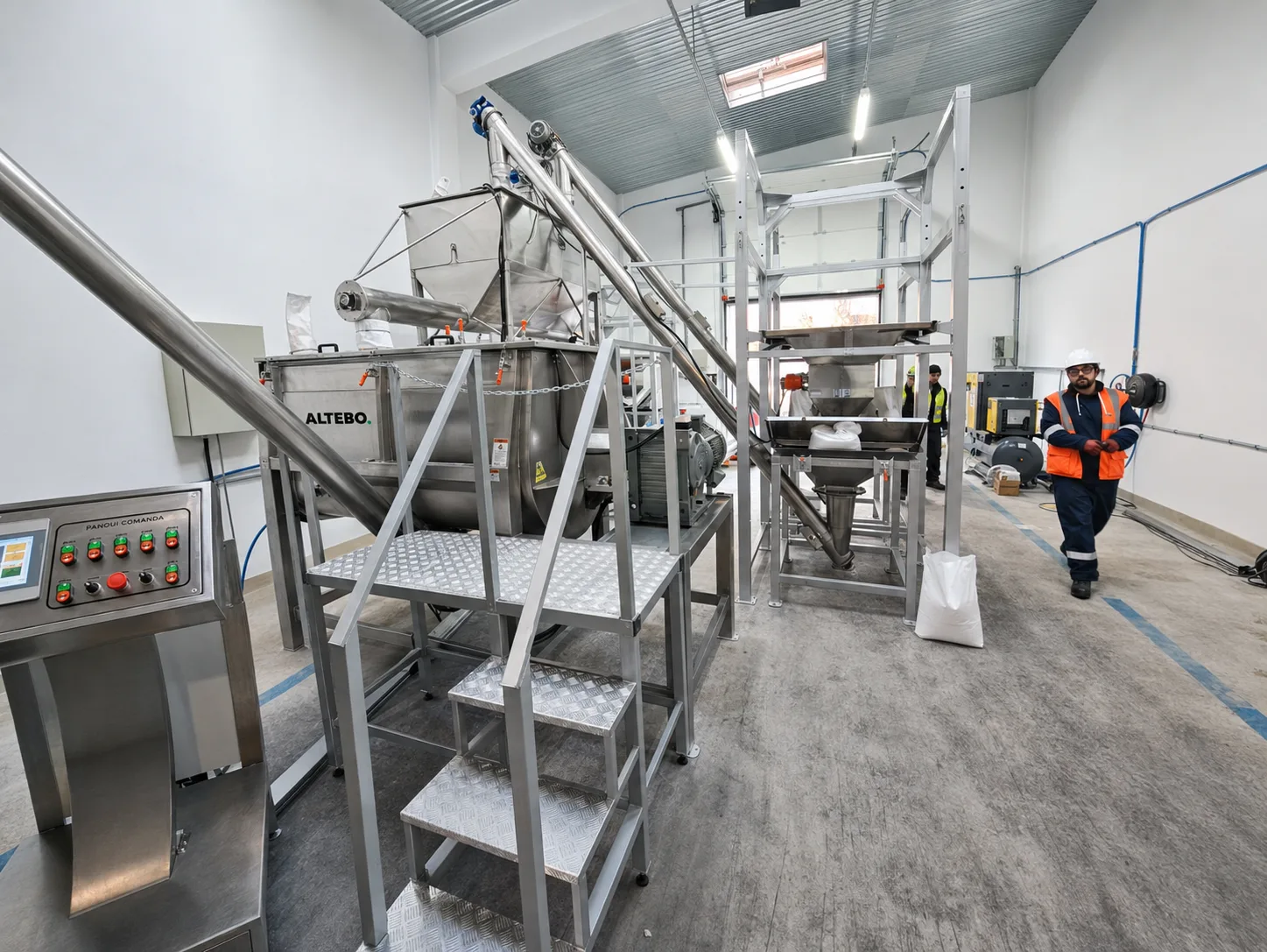
The high-tonnage ribbon blender is intended for production lines working with batches of 5,000 – 20,000 litres: fertiliser plants, construction materials, agricultural premixes and high-volume chemical products. It delivers the same mix quality as the standard models, at industrial production rates.
The ribbon geometry is calculated for the mixing load of the entire batch, the shaft is oversized, and the bearings are mounted outside the trough — clear of the product zone — for reliability and hygiene. The high-torque gearmotor allows the machine to start with a full trough, a mandatory condition in real industrial operation.
The standard build is AISI 304/316L stainless or protected carbon steel, with a reinforced structure and inspection hatches. Optionally, the mixer is mounted on load cells for direct batch weighing and integrated into the line control system, with stored recipes.
Reinforced structure
Trough, shaft and frame sized for the load of multi-tonne batches.
Bearings outside the product zone
High reliability and zero contamination from the rotating parts.
Starts under load
High-torque drive — restarts with a full trough, without emptying it first.
Integrated weighing (optional)
Load cells under the frame, for batches dosed directly into the mixer.
Variante constructive
What actually differs between them — not just what they are called.
AISI 304 / 316L stainless
For agricultural premixes, food products and corrosive media. 316L is specified when the composition contains chlorides or acids.
Corrosion-protected carbon steel
For construction materials and non-aggressive compositions — lower build cost at the same capacity.
On load cells
The frame stands on load cells; the recipe is weighed directly into the mixer, with a report per batch.
Frequently asked questions
Question not answered here? Write to us — an engineer replies, nu un robot.
Does it really start with a full trough?
Yes — that is the main constructional difference from a standard ribbon blender: the gearmotor is selected with a starting torque sized for the mass of the whole batch. In practice, after a line stoppage or a power cut you do not have to empty the trough by hand before restarting.
Why are the bearings mounted outside the trough?
For two reasons: they never touch the product, so they cannot contaminate the batch with lubricant or wear particles, and they do not run in an abrasive environment, which extends their service life. When they are replaced, the work is done from outside, without opening the trough.
Do you build above 20,000 L?
Yes. The 5,000 – 20,000 L range is what we build routinely, not a construction limit — we size to order above it as well. Send us the batch volume, the material density and the required production rate.
How much floor space does it take?
Overall sizes per capacity are in the specification table. Bear in mind that the layout also has to allow for cover opening and access to the gearmotor for maintenance — we include both in the installation drawing.
What is its energy consumption per batch?
Installed power is between 22 and 110 kW depending on capacity and material density, but the actual consumption per batch depends on the mixing time.
Can it be installed in an existing building, or does it need a special foundation?
We check the site before manufacture and supply the foundation drawing with the loads transmitted to the structure.