Industrial mixers
Ribbon blender
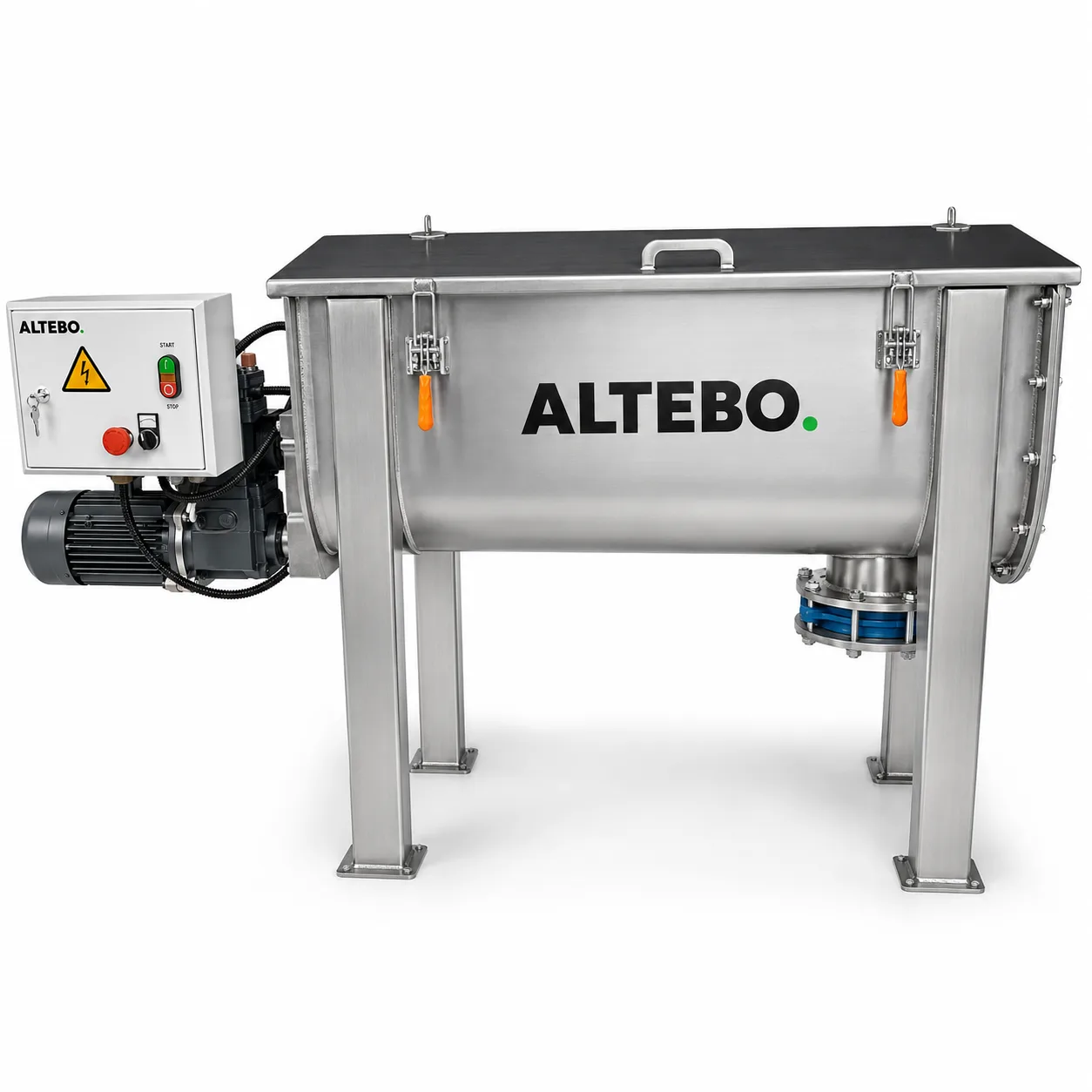
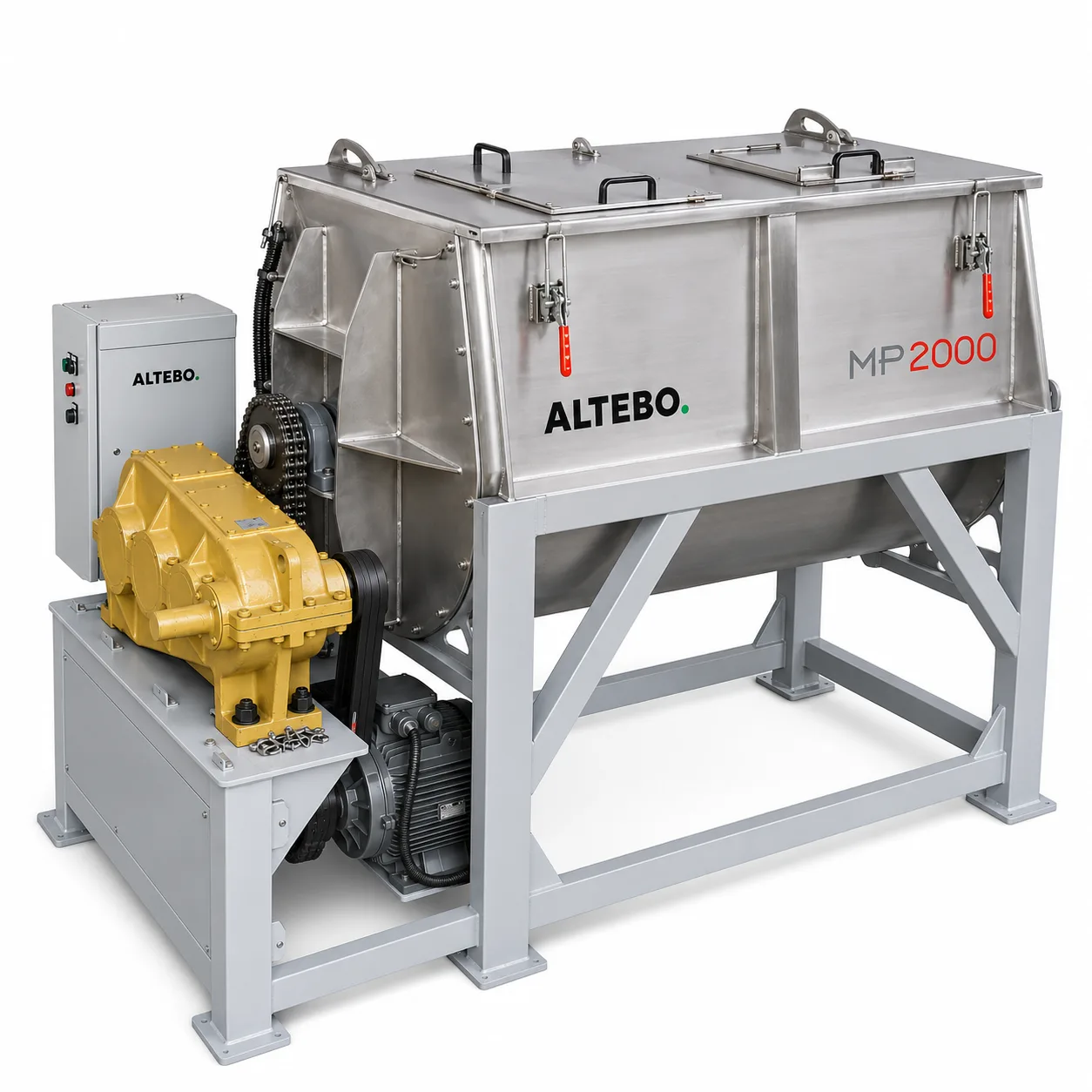
Double ribbon blender for batch homogenising of dry powders and granulates — premixes, spices, flours, pigments, powder detergents. Built routinely from 100 to 10,000 L per batch, in AISI 304 or 316L stainless.
Also known as: ribbon mixer · double ribbon blender · horizontal ribbon mixer
Specifications
| Capacity | 100 – 10,000 L / batch |
|---|---|
| Product contact material | AISI 304 / 316L stainless, sanitary finish on request |
| Motor power | 1.5 – 75 kW |
| Drive | Gearmotor, variable speed from an inverter |
| Discharge | Manual or pneumatic valve |
| Options | Load cells · liquid spray nozzles · heating jacket · sanitary finish |
The figures above are the ranges we build routinely, not construction limits. We design and manufacture any capacity, power rating and envelope to order — including below or above the ranges in the table.
Industrii
- Food
- Pharma
- Chemicals
- Individually sized — on your material, throughput and space
- Technical proposal and price, normally within 48 hours
- Installation, commissioning and service from our own plants
When to choose it
The concrete situations where this machine is the right answer — and the one where we recommend something else from our range.
You have a dry recipe with 2–10 components and need the same result from every batch — the double ribbon is the most predictable mixing principle for free-flowing powders.
You produce food or pharmaceutical products and need to clean between recipes: the U-trough with hinged covers opens along its full length, without dismantling.
You blend components of similar density in comparable proportions — flours, premixes, spices, powder detergents.
You need to add a small proportion of liquid over the dry phase: spray nozzles are fitted in the cover.
When this is NOT the right machine
If the material is a dense paste or a dough — filler, adhesive, plasticised mass — the ribbon slips over the surface instead of working through the mass.
Vezi Z-blade mixerHow it works
The ribbon blender mixes powdered and granular materials in batches, reaching a high degree of homogeneity in short cycle times. It is used widely across the food, pharmaceutical and chemical industries — from premixes, spices and flours through to pigments, detergents and technical powders.
The agitator consists of two concentric helical ribbons wound in opposite directions: the outer ribbon moves material towards the centre of the trough, the inner one towards the ends. The simultaneous axial and radial circulation removes stagnant zones and brings the batch to homogeneity within minutes, at a low specific energy consumption.
The U-shaped trough, the agitator and the discharge port are built in AISI 304 or 316L stainless, with a sanitary finish on request. Hinged covers give full access for inspection and cleaning, shaft seals are selected for the product, and discharge is through a manually or pneumatically actuated valve. Speed is adjusted from a frequency inverter, per recipe.
Counter-rotating double ribbon
Simultaneous axial and radial circulation — homogeneity with no stagnant zones.
Hygienic construction
AISI 304/316L stainless, continuous ground welds, sanitary finish on request.
Controlled discharge
Manual or pneumatic valve, complete emptying of the trough.
Sized on the process
Volume, power and speed set from the density and particle size of the product.
Variante constructive
What actually differs between them — not just what they are called.
U-trough, centre discharge
The standard version. The valve sits at the middle of the trough — the shortest emptying path, suitable when the mixer discharges straight into a hopper below it.
Full-length discharge
A long valve or several valves. Empties significantly faster than the centre version and is the right choice for products that flow poorly.
With a heating jacket
A heating or cooling jacket on the outside of the trough, when the recipe requires controlled temperature during mixing.
On load cells
The mixer sits on load cells and weighs the components directly as they are charged — removing the need for a separate dosing unit upstream.
Frequently asked questions
Question not answered here? Write to us — an engineer replies, nu un robot.
How long does a batch take?
See the “Mixing time” row in the specification table. The actual time depends on the number of components, the density difference between them and the particle size — we establish it during sizing, on your recipe.
What degree of homogeneity does it reach?
Send us the recipe and we can state the homogeneity achievable for that particular composition.
Can I mix different recipes in the same machine without cross-contamination?
Yes, if you specify the version with full-length hinged covers and a sanitary finish: the trough opens completely and can be cleaned without removing the agitator. For allergens or pharmaceutical products we additionally recommend product-specific shaft seals and polished surfaces.
What is the largest capacity you can build?
The range we build routinely is 100 – 10,000 L per batch, but that is not a construction limit — we size to order, including above it. For batches from 5,000 L upwards, also look at the high-tonnage ribbon blender, built specifically to start with a full trough.
Can it be integrated into our existing line control?
Yes. Speed is set from a frequency inverter, and the control can receive recipes and start/stop signals from the line automation.
What is the lead time and what warranty does the machine carry?
We normally send the technical proposal and the price within 48 hours of receiving your process description.