Industrial mixers
Z-blade mixer
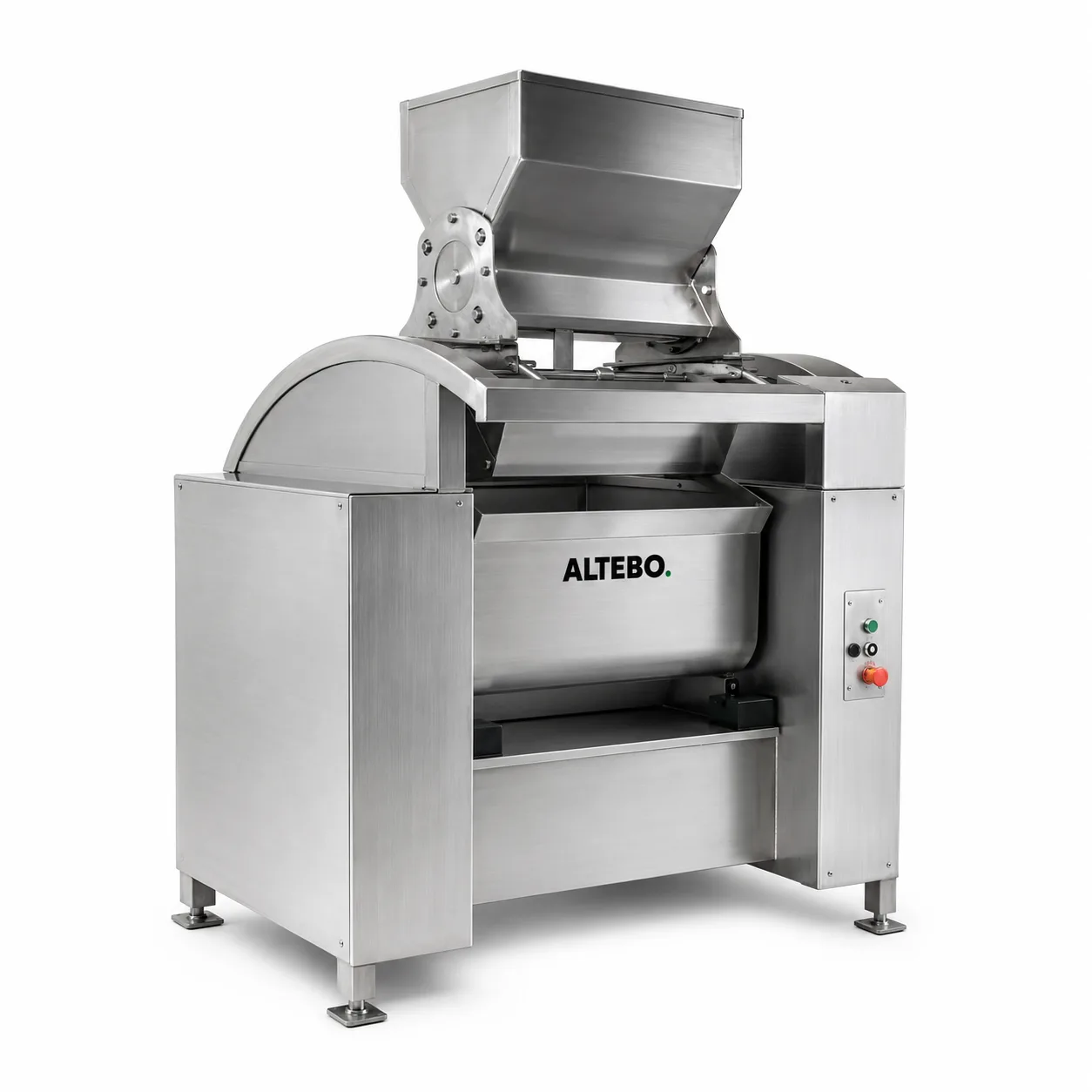
Kneader with two counter-rotating Z-blades for viscous masses — dense doughs, fillers, adhesives, gum base, technical pastes. Built routinely from 50 to 3,000 L per batch.
Also known as: sigma mixer · kneader · double-arm kneading mixer
Individually sized on your material and your process. Technical proposal and price normally within 48 hours. Delivery across the EU and the Republic of Moldova.
How it works
The Z-blade mixer, or kneader, is intended for high-viscosity materials, where mixing means kneading: dense doughs and fillings, gum base, fillers, adhesives, technical pastes and plasticised masses. Where a ribbon or paddle mixer slips over the surface of the product, Z-blades penetrate it and work it through.
The two Z-shaped blades rotate in opposite directions at different speeds, in a trough with a double half-cylinder bottom: the material is stretched, cut and folded continuously between the blades and the trough walls — the classic kneading mechanism, which disperses the components evenly through the viscous mass.
The trough and blades are built in AISI 304/316L stainless or treated steel, with a heating or cooling jacket on request for controlling the temperature of the kneaded mass. Discharge is by hydraulic tilting of the trough or through an extraction screw mounted in its base, and the oversized drive sustains the kneading load in continuous operation.
Counter-rotating Z-blades
Different speeds on the two blades — continuous stretching, cutting and folding.
For high viscosity
Doughs, fillers, adhesives, plasticised masses — worked through in depth.
Controlled temperature
Heating / cooling jacket on the trough, on request.
Tilting or screw discharge
Complete emptying, chosen for the consistency of the product.
When to choose it
The concrete situations in which this machine is the right answer — and the one in which we would point you to something else in our range.
The material is so viscous that a ribbon or paddle mixer turns inside it without working it — Z-blades stretch, cut and fold it.
You produce dense doughs, fillers, adhesives or plasticised masses, where mixing is really mechanical kneading.
The mass heats up from its own friction and has to be cooled, or conversely has to be heated to become workable — the trough is built with a jacket.
The product is too stiff to flow through a valve: the trough tilts hydraulically or is emptied by an extraction screw in its base.
When this is NOT the right machine
For dry, free-flowing powders a kneader is a heavily oversized construction — it draws far more power than the process requires.
See Ribbon blender