Industrial mixers
V-blender
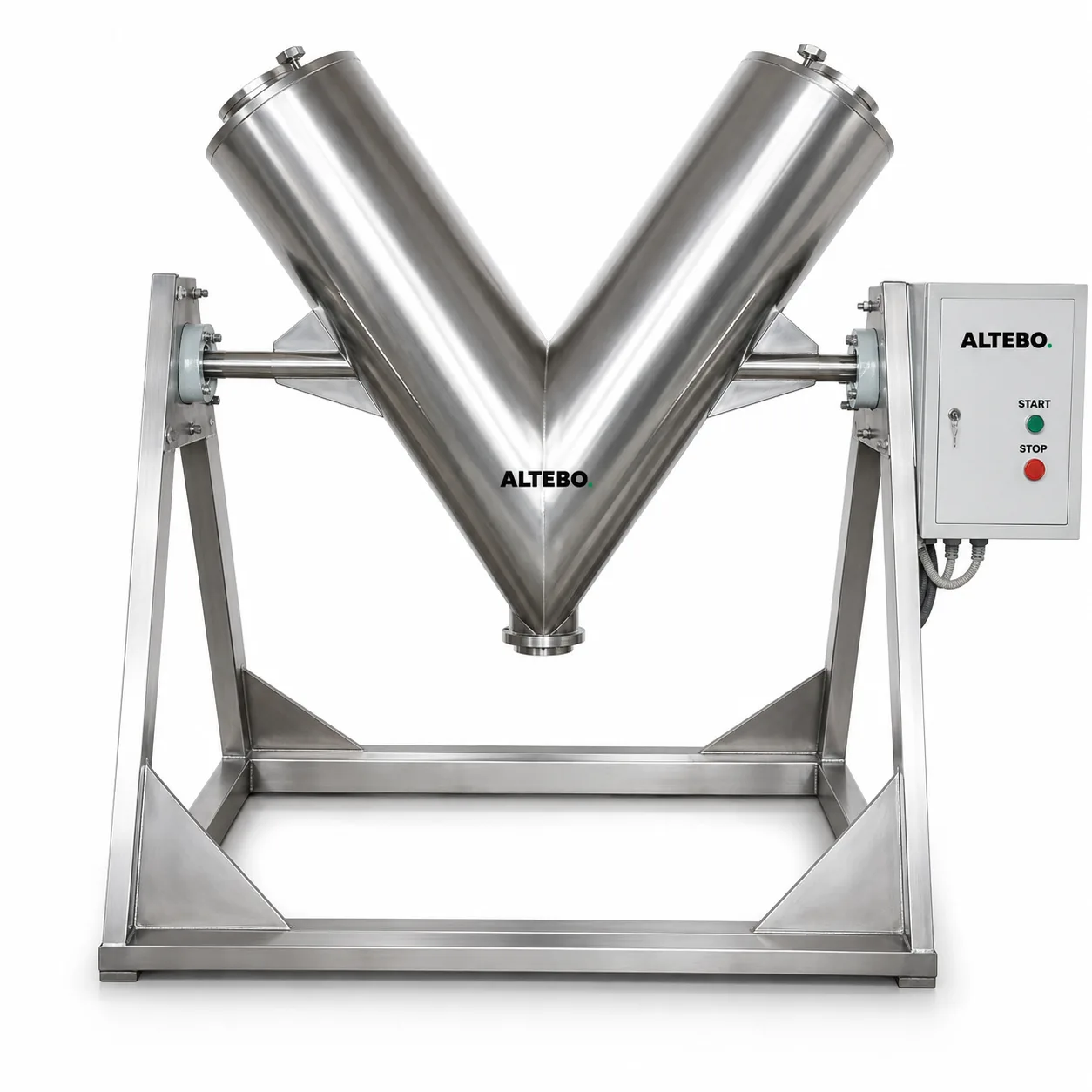
V-blender for homogenising dry powders with no internal mixing tools — pharmaceutical and nutraceutical products, pigments, premixes. Built routinely from 50 to 2,000 L per batch, in polished stainless.
Also known as: V mixer · twin-shell blender · tumble blender
Specifications
| Capacity | 50 – 2,000 L / batch |
|---|---|
| Product contact material | Polished AISI 304 / 316L stainless |
| Motor power | 0.75 – 15 kW |
| Drive | Gearmotor with variable speed |
| Discharge | Butterfly valve, quick-release covers |
| Options | Interlocked perimeter guard · recipe panel · batch barcoding |
The figures above are the ranges we build routinely, not construction limits. We design and manufacture any capacity, power rating and envelope to order — including below or above the ranges in the table.
Industrii
- Pharma
- Food
- Chemicals
- Individually sized — on your material, throughput and space
- Technical proposal and price, normally within 48 hours
- Installation, commissioning and service from our own plants
When to choose it
The concrete situations where this machine is the right answer — and the one where we recommend something else from our range.
You produce in pharma or nutraceuticals, where cleaning has to be validated: the shell has no shaft, bearings or seals inside, so there are no retention pockets to justify.
The powder is sensitive to shear or heat — there is no mixing element pressing it, the action is purely gravitational.
The recipe consists of fine powders of similar particle size, where divide-and-recombine on every rotation gives a statistically uniform distribution.
You need batch traceability: speed and rotation count are programmed per recipe, so the cycle is identical every time.
When this is NOT the right machine
If you need to spray a liquid over the powder, or work with batches above 2,000 L, a rotating shell is the wrong construction — it cannot carry nozzles and cannot support large masses in rotation.
Vezi Paddle mixerHow it works
The V-blender belongs to the tumble-blender family: mixing takes place purely by gravity, through rotation of the whole shell, with no mixing element in contact with the product. It is the standard answer for pharmaceutical, nutraceutical and sensitive food powders, where particle integrity and validatable cleaning are baseline requirements.
On every rotation, the material divides into the two arms of the V-shaped shell and recombines at the junction — a successive divide-and-recombine action that leads to a statistically uniform distribution of the components, without heating or mechanically degrading the product.
The shell is built in AISI 304/316L stainless with polished internal surfaces and no retention pockets; charging and discharging are through quick-release covers and a butterfly valve. Speed and the number of rotations per batch are programmed from the panel, and the interlocked perimeter guard stops the machine if anyone enters the rotating zone.
No internal tools
Purely gravitational mixing — the product suffers no shear.
Successive divide and recombine
Statistically uniform distribution of the components in the batch.
Validatable cleaning
Polished surfaces, no retention pockets — suitable for pharma.
Programmable cycle
Speed and rotation count set per recipe, from the control panel.
Variante constructive
What actually differs between them — not just what they are called.
Plain V shell
The standard version, for blending dry powders.
With barcoding and panel recipes
The cycle (speed, rotation count) is selected per recipe, with the parameters recorded for each batch — for production that requires documented traceability.
With an intensifier bar
An additional rotating element on the rotation axis, used when the recipe contains a low-concentration additive that will not distribute by gravity alone.
Frequently asked questions
Question not answered here? Write to us — an engineer replies, nu un robot.
How full is the shell for one batch?
See the “Fill level” row in the specification table. The shell has to remain partly empty — the free space is what allows the material to divide and recombine on every rotation.
Why is it preferred in the pharmaceutical industry?
Because it has no mixing element inside: no shaft, no bearings, no seals in contact with the product. That means no retention pockets to justify during cleaning validation and no risk of contamination with lubricant or wear particles.
How long is a mixing cycle?
The cycle is expressed in rotations rather than minutes and is established per recipe — after which it stays identical for every batch.
Can I add a liquid to the recipe?
Not in this construction — the whole shell rotates, so it cannot carry a nozzle manifold. For recipes with liquid addition, the right machine is the paddle mixer or the ploughshare mixer with chopper blades.
How is the rotating zone guarded?
With an interlocked perimeter guard: opening the enclosure stops the machine. It is a mandatory safety requirement for a shell of several hundred kilograms in rotation.
What internal finish do you produce?
Polished surfaces with no retention pockets; the Ra value is in the specification table.