Industrial mixers
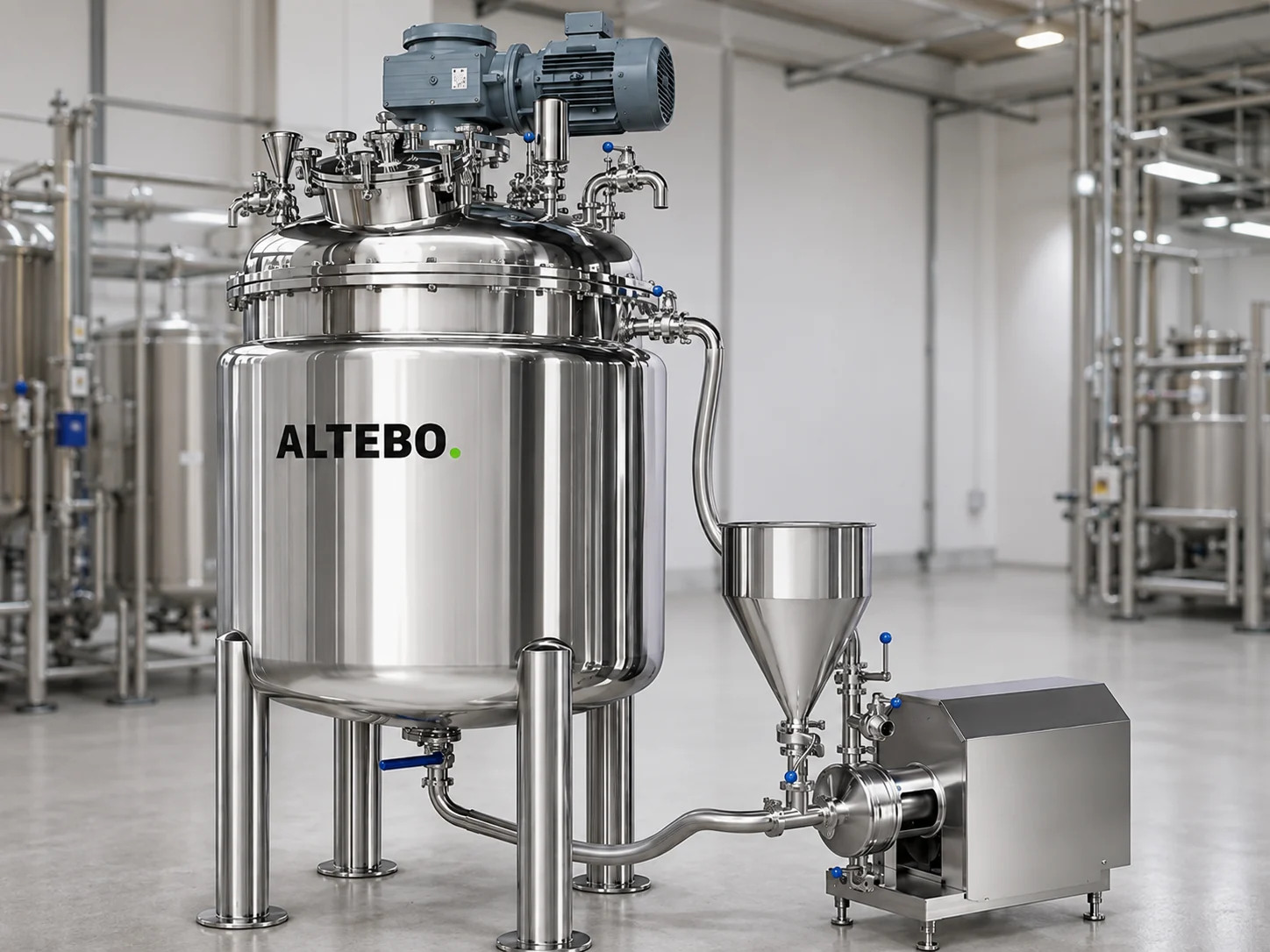
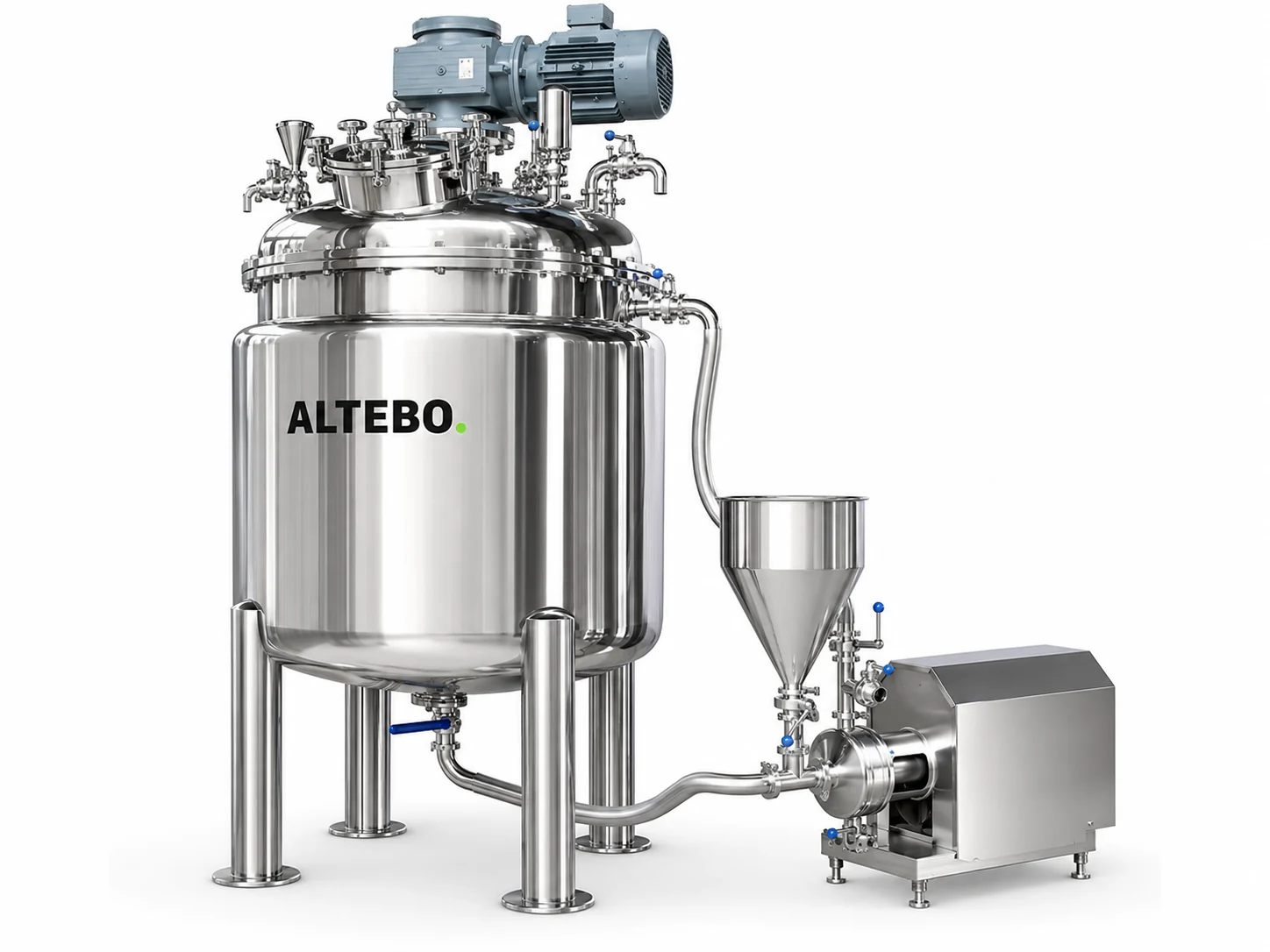
Vacuum homogenizer emulsifier
Precision process system for creams, emulsions, gels and suspensions: AISI 316L vessel with a scraper anchor agitator, a rotor/stator shear head, a thermal jacket, vacuum operation, CIP/SIP and recipe control. Built routinely between approx. 50 and 1,000 L.
- Usual configurable range
- approx. 50 – 1,000 L
- Usual installed power
- approx. 3 – 45 kW
Also known as: vacuum emulsifier · cosmetic cream mixer · vacuum homogenising mixer · cosmetic emulsifying line
Individually sized on your material and your process. Technical proposal and price normally within 48 hours. Delivery across the EU and the Republic of Moldova.
How it works
This is not the largest machine in the Altebo range, and it does not need to be: it is the most precise. A cosmetic cream or a pharmaceutical emulsion is judged on stability, on texture and on the absence of air bubbles — three things that do not come from volume, but from the right combination of vacuum, shear and temperature profile.
Vacuum has two roles. It removes the air entrained during mixing, which would otherwise stay in the finished product as visible bubbles and as oxidation surface. And it allows components to be dissolved and hydrated without foaming. The rotor/stator shear head breaks the dispersed phase down to the droplet size that keeps the emulsion stable, while the scraper anchor agitator provides bulk circulation and lifts the layer stuck to the hot wall.
The jacket heats for melting the fat phase and cools in a controlled way for crystallisation — many emulsions break if cooling is too fast. AISI 316L construction with polished surfaces, CIP and SIP covers the hygiene requirements, and recipe control records temperature, speeds, vacuum and times for every batch, so the next lot comes out identical.
Vacuum throughout the batch
No entrained air: bubbles would otherwise stay in the finished product, visible and acting as oxidation surface.
Scraper anchor plus rotor/stator
Bulk circulation and local shear work at the same time — either one alone is not enough for a stable emulsion.
Controlled temperature profile
Heating to melt the fat phase, controlled cooling for crystallisation — cooling too fast breaks the emulsion.
Recorded recipes
Temperature, speeds, vacuum and times are saved per batch, so the next lot comes out identical.
When to choose it
The concrete situations in which this machine is the right answer — and the one in which we would point you to something else in our range.
You make creams, emulsions or gels in which air bubbles are a visible defect — vacuum is the only method that removes them from the product, not just from the surface.
The emulsion has to hold until its expiry date: stability comes from droplet size, obtained through controlled shear.
The product sticks to the hot wall and has to be lifted off continuously, otherwise it burns locally and changes the colour and smell of the lot.
You need the next lot to come out identical: recorded recipes take the human factor out of reproducibility.
When this is NOT the right machine
If you need large volumes, in the order of thousands of litres, this system is sized for precision, not for tonnage.
See Sterile process reactor